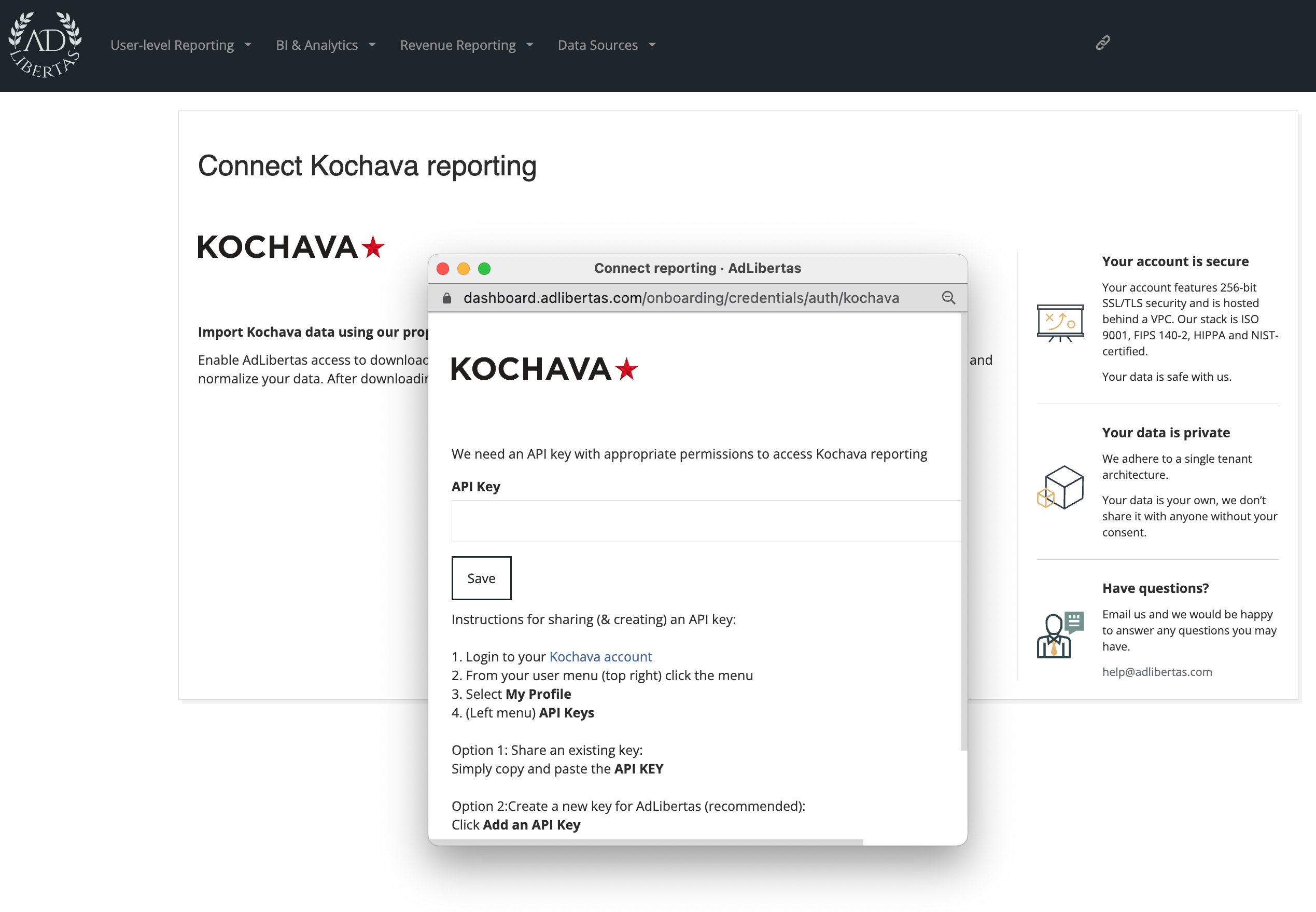
> For the complete documentation index, see [llms.txt](https://docs.adlibertas.com/llms.txt). Markdown versions of documentation pages are available by appending `.md` to page URLs; this page is available as [Markdown](https://docs.adlibertas.com/data-integrations/mmp-connections/connecting-kochava.md).
# Connecting Kochava
### **Overview:**
We connect with Kochava to collect campaign data, and where applicable events tracked by the Kochava SDK.
To connect with Kochava, simply add a user from the Kochava dashboard with the following naming convention:
**\@adlibertas.com**
### **To add a user to Kochava:**
(Referenced from [Kochava Documentation](https://support.kochava.com/reference-information/users-overview/))

1. Log in to Kochava
2. Select the desired Account.
3. Select **Account Options > Users**.
4. Click **Add a User**.
5. Enter the **Username**.
6. Enter the user's **Name**.
7. Enter the user's **Email**.
8. Enter a **Password**.
9. Enter the same **Password** into the **Confirm** field.
10. Select any **Groups** the user will belong to.
11. Select the **Time Zone**.
12. Select the default **Language**:
13. Select the default **Currency**.
14. Click **Submit**.